


Here we are, two women, one mother.
Both of us carrying the same longing for a scent—the remembered bond between our bodies and the body of the land that once held us: our ancestors, their love and losses, our past and our future.
In many earth-based psychological and spiritual frameworks around the world, our attachment to ancestral land, birthplace, and Mother Earth is recognized as foundational to the psyche—the ground of our being.
For tens of thousands of years, across every corner of the Earth, the land to which we belong has never been merely a backdrop to human life. She is ancestor, teacher, law, and living kin. Her embrace holds the interdependence of human and more-than-human beings.
Just as a parent holds the infant body, the land holds the parent, the ancestors, the language, the seasons, the food, the past, and the future.
Our bond with the land is a primary attachment.
And yet this attachment has been collectively and systematically exiled from our awareness since the dawn of the industrial era. This foundation of the psyche is almost invisible in conventional western psychology and practices derived from western psychology. In many psychology textbooks, primary attachment is reduced to the bond between a child and their parents within the nuclear family.
Yet Mother Earth is still reaching out to her children, speaking to us in unexpected ways. This is a story of such a bond between two women and their birthplaces.
It took place a few weeks ago in a setting called Social Alchemy, a collective healing space where about twenty of us gather to heal from the paradigm of isolation and unwind its patterns from our bodies, relationships, and imaginations. My friend and partner Sara and I are co-facilitating this space together. (For more about this project, you may read it here.)
During one of our sessions, Sara and I were demonstrating an exercise. Sara asked me the same question again and again:
“What home would hold you?”
The purpose of the question was not conversation. It was an invitation to penetrate the surface layers of the conscious mind and allow surprising material to rise from the unconscious.
For five minutes, Sara continued to ask, and I continued to answer.
Sara’s presence was like a warm blanket, wrapping me and the mystery held within me in a soft cocoon.
When I had given all the known answers, there came a pause. An emptiness.
Then what? I asked myself silently.
Just then, something rose from the darkness like a butterfly.
“The scent of the little village outside of Shanghai where I was born.”
I could feel my ego mind becoming perplexed by this answer. But the sensation had already gripped me. I continued to paint the image rising from the place inside me that had stored that scent.
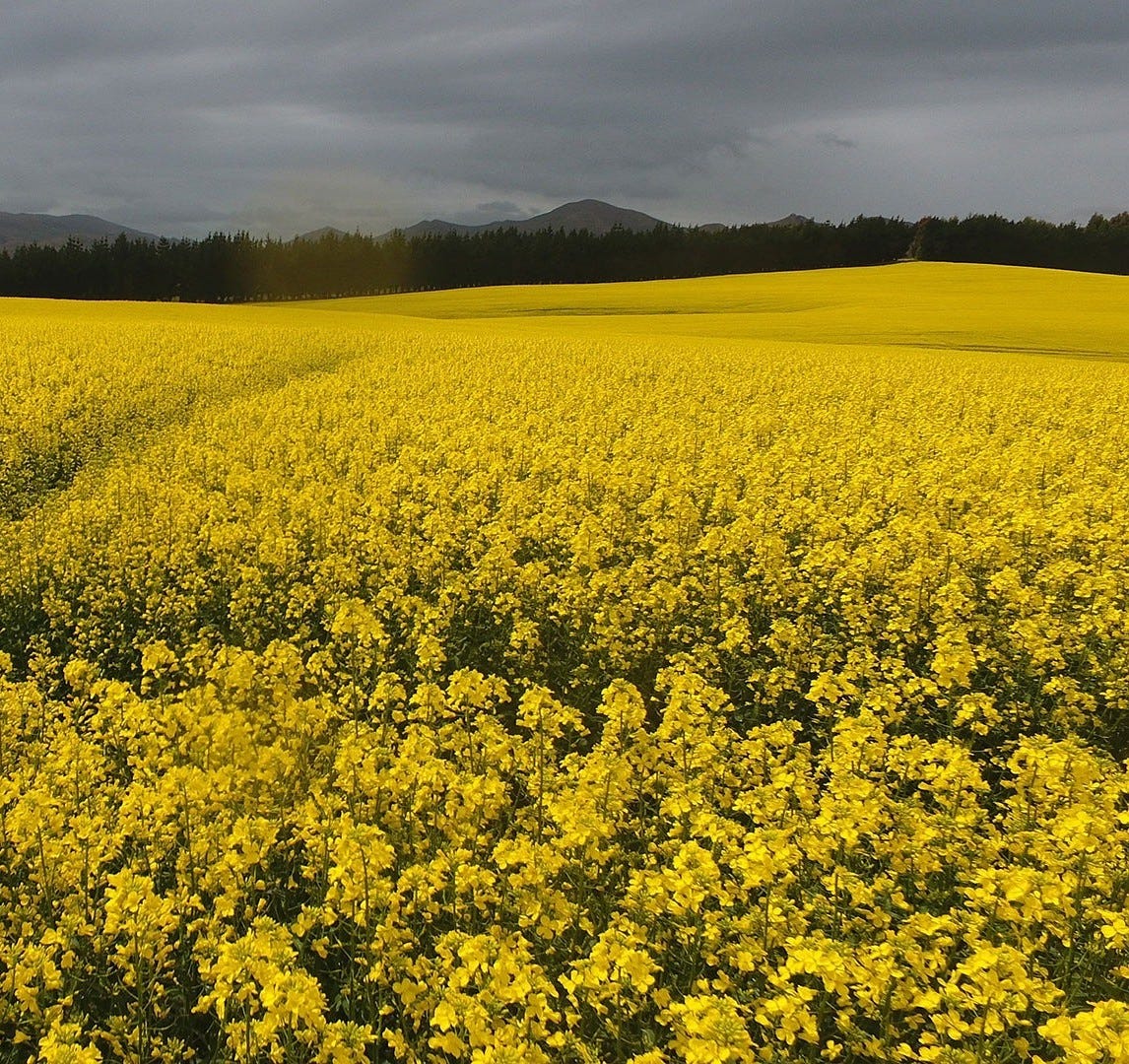
“Oh, that scent… I miss it so much. There were rice paddies, and fields of golden flowers. I don’t know what they are called in English. Oh, how I long for their scent.”
The scent of the golden flowers engulfed me. I was transported back through time. My mind flashed back to when I was a young girl, riding my bicycle through miles and miles of golden flower fields, dotted with pink peach blossoms.
I could feel the wind wrapping itself around that young girl on her bicycle. I could see ten million peach blossoms scattering all around her. I thought I could ride my bicycle through that beauty forever, all the way to the end of time, and be completely content.

The next morning, after I got up, my eyes happened to land on a book sitting on my desk: The Art of Living with Change by Dr. Gong Shu, a Chinese woman, art therapist, and influential figure in the field of psychodrama. Like me, she is an immigrant who has lived in the United States for much of her life. She is also a pioneer in weaving Western psychology with traditional Chinese knowledge.
For reasons I could not explain, I sat down to read.
This was unusual. My mornings are usually devoted to Tai Chi or music practice, a way of setting a contemplative tone for the day. But that morning, despite my routine, my hands began to leaf through the book.
I started crying from the first page.
Dr. Gong is my mother’s age. She was also born in a village near Shanghai, not far from my birthplace. In the introduction, she writes of her earliest memory as a young girl: an encounter with an invading army during World War II. She writes of her love for a homeland torn by war, of her family facing soldiers with guns, of her journey floating between two countries, of being “homeless,” and of turning toward “home-everywhere.”
Just as the resonance I felt with her began to swell like a wave in my chest, I came upon this passage. I could hardly believe my eyes:
“I remember when I was about four years old; we lived in the countryside on a little island in the mouth of the Yangzi River near Shanghai. One early summer morning, I went outside. I saw suddenly in front of me a field of golden vegetable flowers. The fresh smell of the bright golden color was so enticing that I flung myself into the flowers and wallowed in the field. Later I saw golden flowers elsewhere, but they were never as fresh, golden, or enticing as the first time I experienced them as a child.”
I was completely undone.
I cried…
like a lost child
who had finally found her mother.
Here we are,
two women,
one mother.
Both of us carrying the same longing for a scent—the remembered bond between our bodies and the body of the land that once held us: our ancestors, their love and losses, our past and our future.
After the wave of emotion finally subsides, I wrote these words:
The scent of flowers from my homeland
planted seeds
in the dark soil of my imagination.
Through the long years
of my meandering wander,
those seeds have been searching
for a new place to land—
somewhere they may take root,
open their delicate faces to the sun,
and blossom once more
into a field
of golden flowers.
How very beautiful. Thank you so much for putting words to your golden experience of home and how you found it once again. I really like that our original home is the land Many blessings.