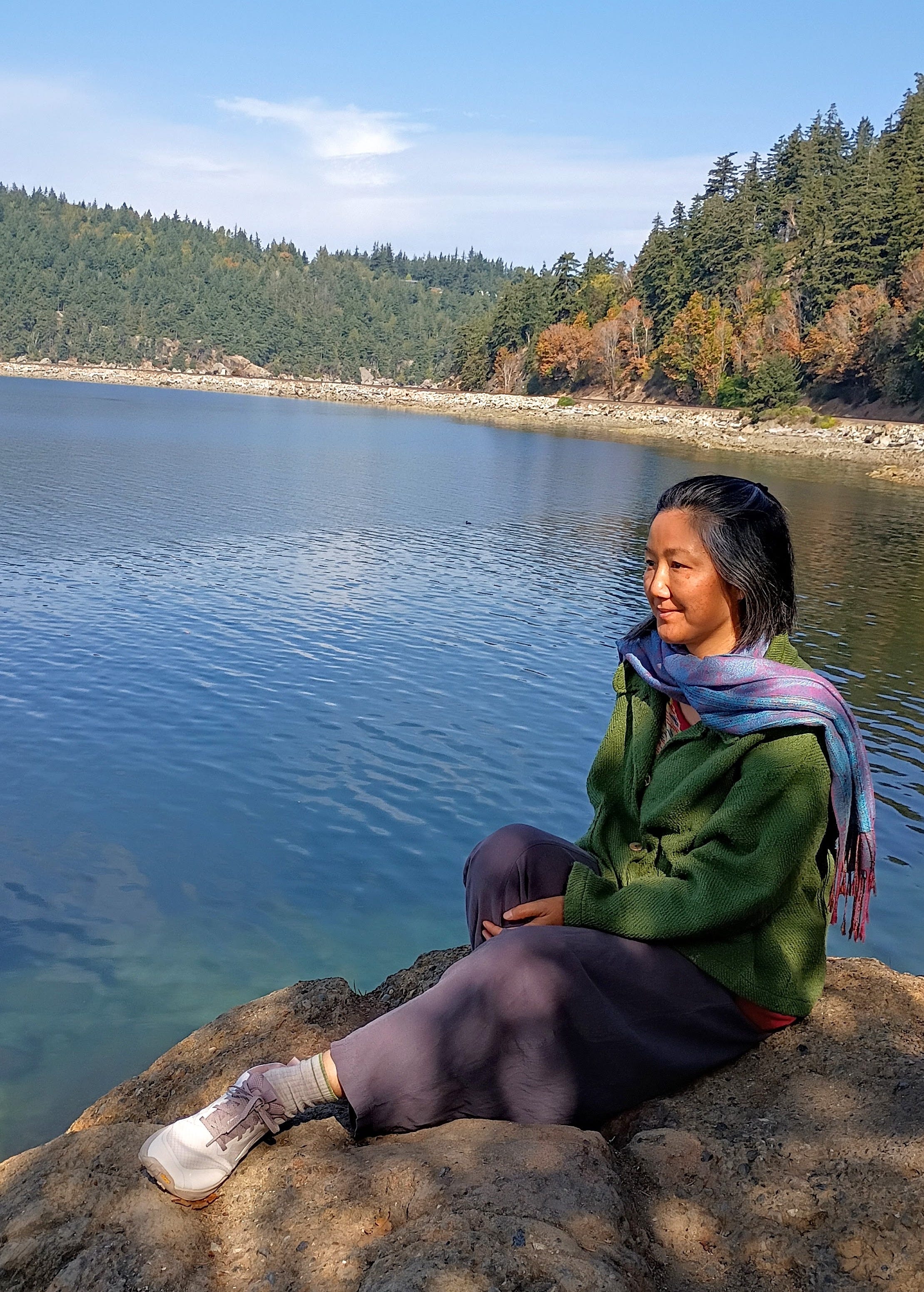


Cultural Field is Part of the Ecology
In the ancient Taoist worldview, the human body is understood as a microcosmic expression of the larger universe. Qi, the universal life force that moves through mountains, rivers, weather, seasons, plants, and animals, also moves through our digestive, respiratory, and nervous systems.
Through this lens, qigong—a practice for cultivating harmony among body, mind, and heart—is not merely a personal practice.
It is also a form of ecological activism.
Many people who are drawn to qigong today belong to an emerging tribe I think of as regenerative culture growers. I count myself among this tribe. Unwinding ourselves from extractive and unsustainable paradigms—capitalism, materialism, colonialism, and other systems that separate us from body, community, and Earth—we are actively cultivating a culture that values embodiment, relational reciprocity, creativity, and embrace many diverse ways of being and knowing. We grow these values through the ways we relate to family, whether of origin or chosen, to community, to land and to the people with whom we create and collaborate.
From a Taoist perspective, the energy and attention exchanged through these relational fields are expressions of the same living currents that move ocean tides, turn the seasons, and sustain the dynamic balance of ecosystems. Modern science may not yet have language for all of these subtler dimensions of relationship, yet many of us can feel them directly: currents of connection that weave our bodies and lives together with forests, waterways, weather systems, and oceans.
Qigong offers a way of becoming more sensitive to these currents—and of learning how to participate in them with greater awareness.
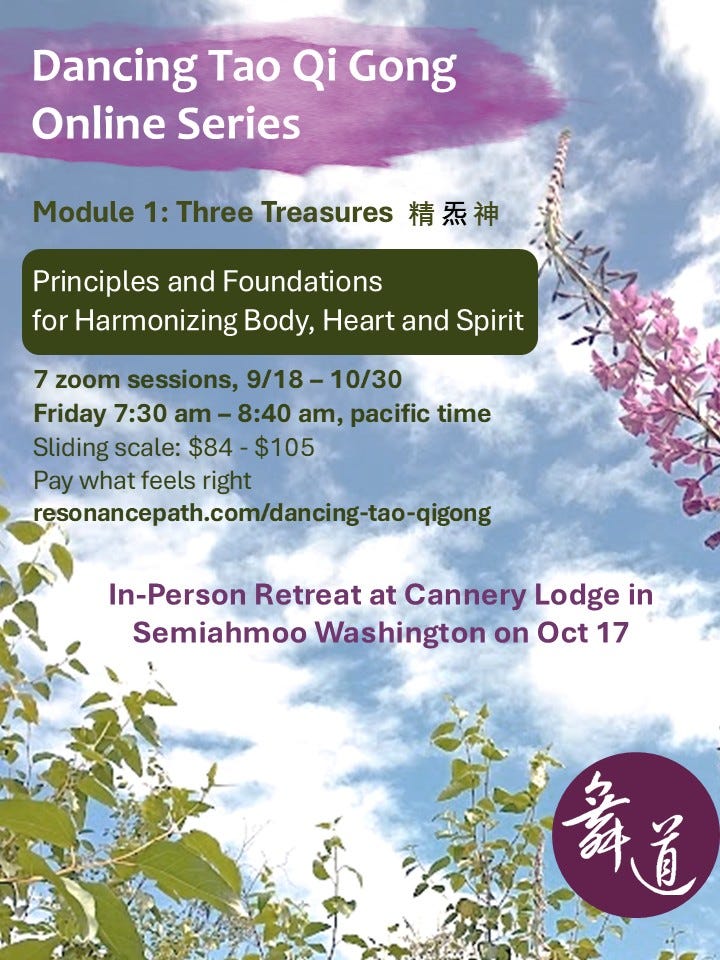
Upcoming qigong class
A Journey of Remembering of An Ancient Way of Knowing
In many ancient traditions, shamans and medicine people cultivated an intimate sensitivity to the movements of the natural world. They did not relate to nature primarily as something external to be controlled, extracted from, profited from, or manipulated through force. Instead, they learned to attune their inner ecology to the outer ecology, using the body almost like a tuning fork within a much larger living field.
Through this kind of attunement, they could perceive subtle changes in weather, foresee natural events, and sometimes participate ritually in calling rain or snow. Their knowing did not depend only on observation and analysis. It arose through the body, intuition, dreams, relationships, and long immersion in the living world.
Two beautiful books that I love offer glimpses into this way of being.
The first is Original Wisdom by Robert Wolff, which recounts the author’s encounters with Indigenous people in Southeast Asia, especially the Sng’oi of Malaysia. Wolff describes a way of knowing rooted in bodily sensing, intuition, dreams, and a profound intimacy with the forest—one in which the boundary between self and environment is far more porous than in modern industrial culture.
The second is The Wind Is My Mother, which shares the life and teachings of Bear Heart, a Native American medicine man. His stories convey a way of living in which wind, animals, plants, dreams, ancestors, and human beings all participate in an ongoing field of relationship.
Both books remind us that this sensitivity is not something supernatural or exotic. It may be a human capacity that becomes available when we learn to quiet ourselves, listen deeply, and remember that we are participants in nature rather than observers standing outside of it. This is also what we practice in qigong: refining our sensitivity to breath, sensation, movement, and qi until the body becomes quiet enough to perceive its ongoing conversation with the larger living world.

The Chinese language still carries imprints of this ancient understanding. Weather is 天气 (tiānqì)—literally, the qi of Heaven or sky. Climate is 气象 (qìxiàng), the manifestations, appearances, and patterns of qi in the atmosphere. Even in everyday language, the movements of the sky and earth are still spoken of through the language of qi.
I believe we are on a journey of collectively remembering this ancient way of knowing.
Remembering, however, does not mean simply repeating the practices of the past. The ecological, cultural, and social conditions that gave birth to ancient traditions have changed dramatically. Practices that arose within a particular landscape, community, or way of life cannot always be transplanted intact into the modern world and remain alive.
What we can recover is something deeper than form: the felt understanding that our own qi is continuous with the qi of the living world.
From this remembering, new practices can grow. Throughout China’s five thousand years of recorded history, traditions and lineages have never remained static. They have continually changed, adapted, and given rise to new forms in response to shifting cultural, social, and ecological landscapes. Today, amid the speed and intensity of modern development, new forms of practice continue to emerge—seeking not simply to preserve tradition unchanged, but to carry its living essence into the realities of contemporary life.
As this sense of continuity between our qi and the qi of the living world becomes embodied, we can carry it into the day-to-day conditions of our lives. Through our bodies, we may become conduits for the presence of the forests, mountains, rivers, and creatures we love. The mountain does not remain somewhere “out there.” Its steadiness can enter the way we stand. The river can teach our nervous system how to flow. The forest can reshape how we understand community.
To sustain the new culture which we are weaving and growing together, we may need to embody the fierceness of the tiger, the far-seeing sharpness of the eagle, and perhaps even the cunning adaptability of the fox. These qualities are intelligence dormant in the larger field of life from which our own bodies emerged. Qigong practices such as the traditional Animal Frolics (another module for 2027) can help us awaken and embody these different expressions of intelligence.
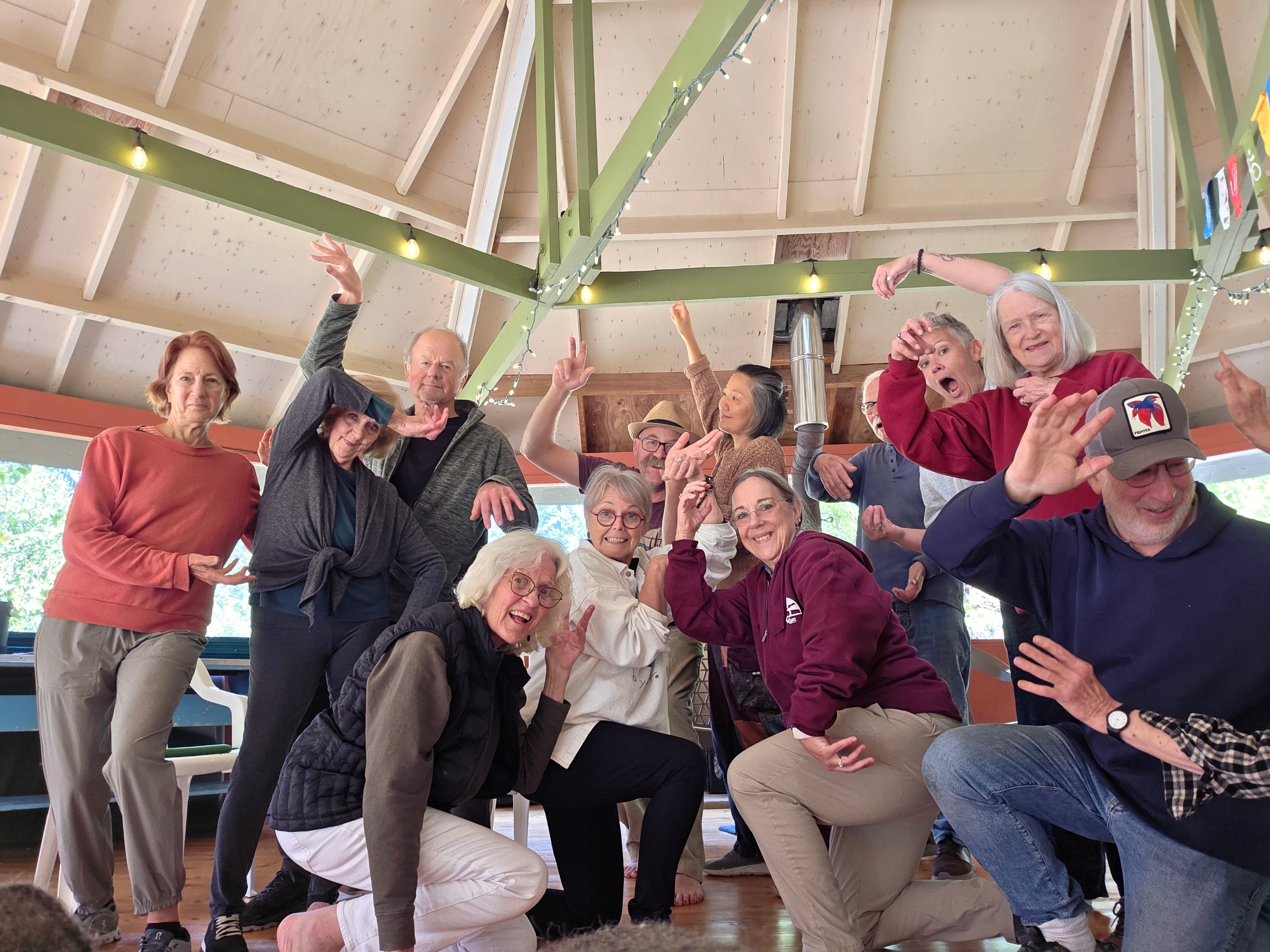
Qigong can become a practice of remembering this unity.
As we learn to sense the movement of life within the body, we may also become more sensitive to the currents moving through relationships, communities, seasons, landscapes, and the more-than-human world. Gradually, the boundary between “my energy” and “the energy of the world” becomes less absolute.
Rather than conducting our lives from the assumption that we are separate individuals moving through an external environment, we begin to live from a deeper recognition:
Ecology is not only around us.
Ecology is moving through us.
Find out more about the 7-week qigong class.